
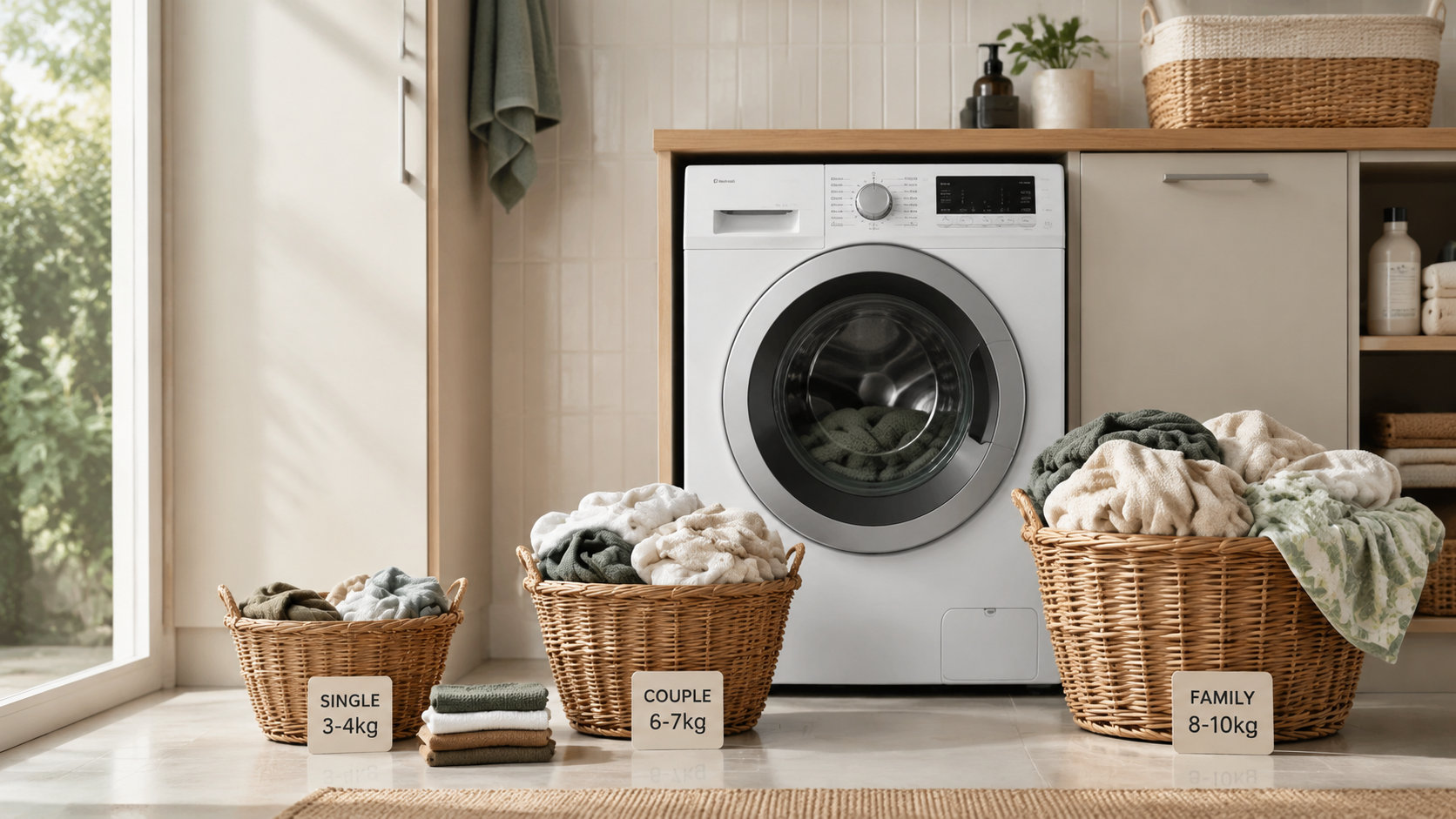
Choosing a washing machine is easier once you narrow the decision down to a few practical questions: how much laundry your household produces, how much room you have, which loading style suits you, and which features will genuinely make washing easier.
So, what size washing machine do I need? A couple washing a few loads each week may need far less capacity than a family managing uniforms, towels and bedding. At the same time, choosing the largest machine available can mean paying for capacity you rarely use.
This washing machine capacity guide covers the main factors to compare before committing. You can also look through our laundry appliance range if you are setting up the full laundry at the same time.
What Size Washing Machine Do I Need for My Household?
Capacity is measured in kilograms and refers to the maximum weight of dry laundry the drum is designed to handle in one cycle. You do not need to fill the machine to its limit every time, but the capacity should comfortably cover your typical loads.
As a practical starting point:
- 1–2 people: around 6–7.5kg can suit everyday clothing and regular smaller loads.
- 3–4 people: around 8–9.5kg gives more room for towels, bedding and family washing.
- 5+ people: 10kg or more may suit larger households producing frequent or bulky loads.
| Household | Starting capacity | Consider increasing capacity if… |
| 1–2 people | 6–7.5kg | Regularly washing bedding, sports/work gear |
| 3–4 people | 8–9.5kg | Frequent towels, uniforms or bulky loads |
| 5+ people | 10kg+ | Large or frequent household loads |
*These are practical starting points rather than fixed rules. Your laundry habits and the types of items you regularly wash can affect the capacity you need.
Laundry habits matter as much as household size. A couple who regularly washes doonas, sports gear or work clothes may benefit from more capacity than another two-person household. Likewise, a family that washes several small loads throughout the week may not need the biggest drum available.
For a mid-sized household, a 9.5kg front load washer provides an example of the capacity available between standard family machines and very large units.
For households with five or more people, or those frequently washing bulky bedding, a 12kg top load washing machine shows how additional drum capacity can reduce the need to split larger loads.
If you are trying to choose the best washing machine for a family, start by looking at your busiest laundry day rather than your lightest. The right capacity should handle regular family washing comfortably without requiring you to overload the drum.
Front Load or Top Load: Which Is Better?
The front load vs top load washing machine decision usually comes down to space, loading preference, wash efficiency and cycle style. Front loaders use a horizontal drum and tumble clothes through the wash. They are generally known for efficient water use and can often be stacked with a compatible dryer, which is useful in smaller laundries. Their door opens from the front, so you need enough clearance directly in front of the machine.
Top loaders open from above. Many households like them because clothing can be loaded without bending as far, and wash cycles can be relatively straightforward. They also require clear space above the machine so the lid can open fully.
Neither style is automatically right for every household.
A front loader may suit you if floor space is limited, you want the option to stack appliances, or water and energy efficiency are high priorities. A top loader may suit you if easy loading is important, you prefer access from above, or your laundry layout already suits a top-opening machine. There are other differences in wash programs, cycle times, spin speeds and installation requirements, but there is no need to repeat the full comparison here. Our front load vs top load guide covers those differences in more detail.
Front Loader vs Top Loader at a Glance
| Consideration | Front loader | Top loader |
| Loading | Front access | Top access |
| Space needed | Door clearance in front | Lid clearance above |
| Stacking | Often possible with compatible dryer | Generally not |
| Water efficiency | Often a strength | Varies by model |
| Accessibility | Requires more bending | Easier top access |
| Best choice | Depends on space and household needs | Depends on space and household needs |
What Are Standard Washing Machine Dimensions and How Should I Measure?
Capacity does not tell you the physical size of a washing machine. Two machines with similar kilogram ratings can have different dimensions, so always check the measurements of the individual model.
Many front loaders are roughly 600–700mm wide and deep and around 800–900mm high, but model dimensions vary. Top loaders can also vary considerably, particularly in depth and height.
Before choosing a machine, measure:
- the available width, depth and height
- doorway and hallway access for delivery
- space needed for hoses and connections behind the machine
- clearance for a front door or top lid to open
- nearby cupboards, benches or other appliances.
Do not measure the laundry recess alone. Think about how the machine will physically reach that space. A model that fits perfectly once installed is still unsuitable if it cannot pass through a narrow doorway or hallway.
If your laundry area has limited floor space, a washer dryer combo may be worth considering. Combining washing and drying functions into one appliance can remove the need for a separate dryer, although you should still check the washing and drying capacities independently.
Allow some breathing room around the appliance as well. Hoses need space behind the machine, and doors or lids should open without hitting walls, shelving or other appliances.
What Washing Machine Features Actually Matter?
Feature lists can become long, but most households only need a small number of functions they will genuinely use. A quick-wash cycle can be useful for lightly soiled clothing when time is limited. Delicate or wool programs help protect sensitive fabrics, while heavier cycles may suit towels, bedding and work clothes.
Spin speed is also worth checking. Faster spin cycles remove more moisture from clothing, which can reduce drying time afterwards. This can be particularly useful if you regularly use a dryer or need clothes to air-dry indoors.
Delay-start functions may help households schedule washing around work, sleep or electricity tariffs. Automatic detergent dosing can also reduce guesswork, although it is more of a convenience feature than an essential one.
Smartphone control, app notifications and other connected features may appeal to some households, but they should not take priority over capacity, reliability, wash programs, ease of loading and dimensions.
The most useful question is not “Which machine has the most features?” but “Which features will actually change the way I do laundry?” For a family, that could mean prioritising capacity, quick washes and durable everyday cycles. For a couple in an apartment, quieter operation, efficient washing and space-saving installation may matter more.
Is an Energy-Efficient Washing Machine Worth It?
Energy and water efficiency affect the ongoing cost of using the appliance, so they are worth considering even when you are renting rather than buying. Washing machines sold in Australia carry energy and water-efficiency information that allows you to compare models of a similar size. Higher efficiency can mean lower electricity or water consumption per wash, although actual running costs depend on your household’s usage, wash temperature and local utility prices.
When comparing models, try to compare machines with similar capacities. A larger machine may have a strong star rating but still consume more energy overall than a smaller machine because it is designed to wash bigger loads.
Cold-water cycles can also reduce energy use because the machine does not need to heat the wash water. For everyday clothing that does not require a hot cycle, this can be a simple way to keep running costs down.
Front loaders often perform strongly on water efficiency, which may be useful for households completing several loads each week. However, energy performance should still be balanced against convenience, price, capacity and the physical layout of your laundry.
An efficient model may cost slightly more through a washing machine rental, but the weekly rental price should not be considered in isolation. Compare likely utility costs, expected usage and the features you actually need.
How Much Should I Budget for a Washing Machine Rental?
The amount you should budget depends mainly on capacity, model type and features. Smaller-capacity machines usually sit at the lower end of the price range, while larger family models and feature-rich front loaders can cost more. Instead of automatically choosing the cheapest weekly option, work out what capacity and functions your household genuinely requires first.
If a lower-priced machine means running extra loads because the drum is too small, the saving may not be worthwhile. Equally, paying more for a very large machine that spends most cycles half empty may not offer good value.
A washing machine rental can make sense for renters, recent movers or households that need an appliance without making a large upfront purchase. It can also provide flexibility if your housing situation or family needs are likely to change.
Before you rent a washing machine, check the total payment commitment, agreement length, maintenance arrangements and any conditions that apply to changes or early termination. The weekly figure is only one part of the overall cost.
Our Consumer Leasing in Australia – Complete Guide explains how consumer leases work, including payments, costs, agreement terms and what happens at the end of an agreement.
For a clearer breakdown of payments, costs, agreement terms, and end-of-lease arrangements, read our Consumer Leasing in Australia – Complete Guide before committing to a rental agreement.
Your utility expenses matter as well. A machine with an appropriate capacity and good efficiency can help limit unnecessary water and power use over the rental period.
Washing Machine Buying and Rental Checklist
Before making your final choice:
- Count the people in your household and estimate your usual laundry volume.
- Choose a capacity that can handle your normal and occasional bulky loads.
- Decide if a front loader or top loader better suits your space and loading preferences.
- Measure the laundry recess, access path, doorways and required opening clearance.
- Identify the wash programs and features you will realistically use.
- Compare energy and water efficiency between machines of a similar capacity.
- Check the weekly cost alongside the full rental commitment.
- Review maintenance and repair arrangements before signing.
- Confirm the appliance can be delivered and installed in the available space.
The checklist is most useful when followed in that order. Capacity and physical fit should come before optional features or price comparisons because the cheapest machine is of poor value if it does not suit your household.
Choose the Washing Machine That Fits Your Household
The answer to “what size washing machine do I need?” starts with household size, but capacity is only part of the decision. A suitable machine should handle your regular loads, fit comfortably in the laundry, provide the programs you actually use and operate at a running cost you are comfortable with. Front and top loaders each have advantages, so the better option is the one that suits your space and routine.
For households looking to avoid a large upfront appliance purchase, rental can provide another way to access the right capacity without buying immediately. Before choosing a machine, review our Consumer Leasing in Australia – Complete Guide for more information about rental payments, costs, agreement terms, and what happens at the end of a consumer lease. Then, compare the available machines against your household requirements rather than choosing purely on weekly price.
Can’t find the product you’re looking for? Contact our customer service team. We’re ready to help you find an appliance that suits your home, available space and budget.
FAQs

Reviewed by
Dean Hawes has more than nine years’ experience in Australia’s consumer leasing industry and reviews our content to help ensure it is accurate, practical and up to date. Drawing on his expertise in consumer leasing, affordability assessments, and household appliance and furniture rental, he helps Australians make informed leasing decisions.