Centrepay Will Stop. YOUR LEASE WILL NOT. Switch to PayTo Now. Contact Sam on 0438 270 915. ACTION REQUIRED BEFORE 1 NOVEMBER 2026. (Learn More)

Laundry fit guide
Reviewed by Dean Hawes, Consumer Leasing Specialist, Lightning Rentals. Last reviewed 2026
To measure for a washing machine, record the width, height, and depth of your available space, then add extra allowance for hoses, taps, drainage, power, and plumbing. Front loaders need clearance for the door to open fully and access in front for loading. Top loaders need overhead clearance for the lid. Always check the actual product’s listed dimensions before committing, since sizes vary between models.
For a dryer, measure its position separately, including ventilation, electrical access, and the door swing. If you plan to stack a dryer or choose a washer–dryer combo, check the installation requirements and dimensions of that specific arrangement.
For the broader process of checking room space, operating clearance, and delivery access, refer to our Home Fit Guide. (pending — activate once hub is live)
On this page
Why washing machine measurements matter before you rent
A washing machine has to fit more than the visible laundry recess. It also needs room for connections, airflow, loading, and normal operation. A model that fits on paper may still project beyond the bench, prevent a door or lid from opening, or place pressure on hoses behind the machine.
Accurate measurements also help you check the delivery route before the appliance arrives. Record the available space, note fixed obstructions, and compare every figure with the individual product listing and manufacturer instructions.
Measuring your available space
Width
Measure the recess from side to side at the front, middle, and back. Use the narrowest figure, especially if skirting boards, pipework, or cabinetry reduce the opening. Many front loaders are approximately 595–600 mm wide, but that range is only a starting point; the listed width of the exact model is the figure that matters.
Height
Measure from the finished floor to the lowest fixed point above the machine. For an under-bench position, check the underside of the bench across the full recess rather than measuring at one point. Front loaders are commonly around 850 mm high, while top loaders are often taller, but model dimensions vary.
Depth
Measure from the back wall to the front edge of the available area. Then account for hoses, taps, plugs, door profiles, and controls that may extend beyond the cabinet. Published depth may describe the main body only, so review the product diagram and installation instructions for protruding parts.
Measurements to record
Record these measurements before comparing washing machines, dryers, or washer–dryer combos.
| Measurement or check | What to record |
|---|---|
|
Available width |
The narrowest width of the appliance space, in mm. |
|
Available height |
The distance from the floor to the lowest overhead obstruction, in mm.
|
|
Available depth |
The depth of the space, allowing for connections and protruding parts. |
|
Door or lid clearance |
The space available to open the door or lid fully and load the appliance. |
|
Connection space |
Room for hoses, taps, plugs, and any required drainage connections. |
|
Dryer ventilation |
Space for the model’s required airflow and any exhaust ducting. |
|
Stacked installation |
The total installed height, including the compatible stacking kit and required clearance. |
|
Delivery access |
The narrowest doorway or passage, plus any tight corners, stairs, or other restrictions. |
Once you have recorded your measurements, compare washing machines and dryers that suit your space.
If your delivery route includes narrow doorways or tight corners, contact our team to discuss access before choosing a model.
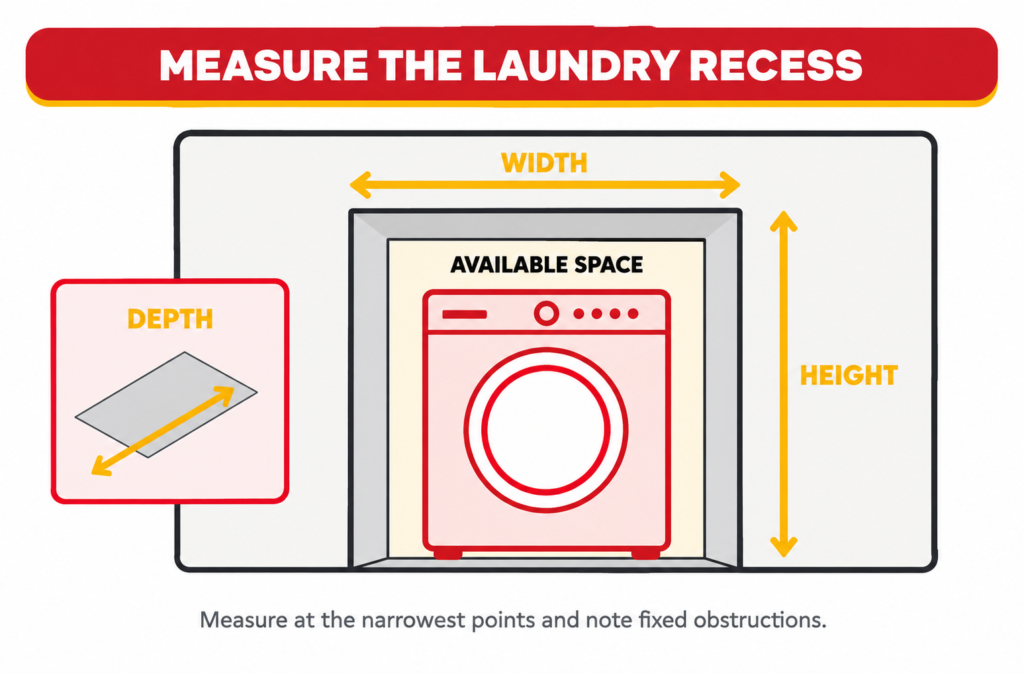
Laundry recess measuring diagram.
Allowing additional space beyond the machine itself
Hoses
Inlet and drain hoses need space to run without sharp bends, crushing, or tension. Check where each hose exits the appliance and where it must connect, then follow the clearance shown in the manufacturer’s installation instructions. As a general guide, leave at least 50mm of clearance around the appliance for airflow and hose access.
Taps
Locate the taps before choosing a machine. They must remain reachable and should not force the appliance too far forward. Include tap handles and fittings when you measure the rear space.
Drain
Confirm the drain point’s position and the route the drain hose must take. The hose should reach without stretching or being trapped behind the appliance. Installation requirements differ, so check the model instructions and the existing laundry setup.
Power
Identify the power point and make sure the plug can be connected without being compressed behind the machine. Avoid planning around an extension lead. If the outlet position is unsuitable, seek advice from a licensed electrician.
Plumbing
Check that the available connections suit the appliance and remain accessible for installation and servicing. Do not assume a previous machine’s arrangement will suit a different model. A licensed plumber can advise if connections need to be altered.
Ventilation where relevant
Leave the ventilation space specified for the model, particularly inside cabinetry or a tight alcove. Adequate space helps heat and moisture disperse and prevents the machine from sitting hard against surrounding surfaces.
Measuring for a front loader
The measuring steps below differ by format. If you haven’t chosen between the two yet, see our guide to front-load vs top-load washing machines.
Front door opening clearance
Measure the full swing of the door, not only the appliance body. Check that the open door will not hit a wall, cabinet, laundry door, or another appliance. The hinge side also affects how easily you can load the drum in a narrow room.
Access in front of the machine
Allow enough clear floor space to stand in front of the machine and move a laundry basket into position. Include nearby doors and cupboards in this check, since they may compete for the same space.
Under-bench installation considerations
Compare the appliance height with the lowest point beneath the bench, then check depth, ventilation, connections, and door clearance. A compact-format option such as a front-load washer and dryer combo may reduce the number of appliances needed, but its exact listed dimensions and installation instructions still determine if it fits.
Stacking considerations
Stacking requires compatible appliances, a manufacturer-approved kit, stable flooring, and enough total height. Confirm the washer, dryer, and kit are designed to work together. For example, a laundry stacking kit is made for specified compatible models and should not be treated as a universal fitting.
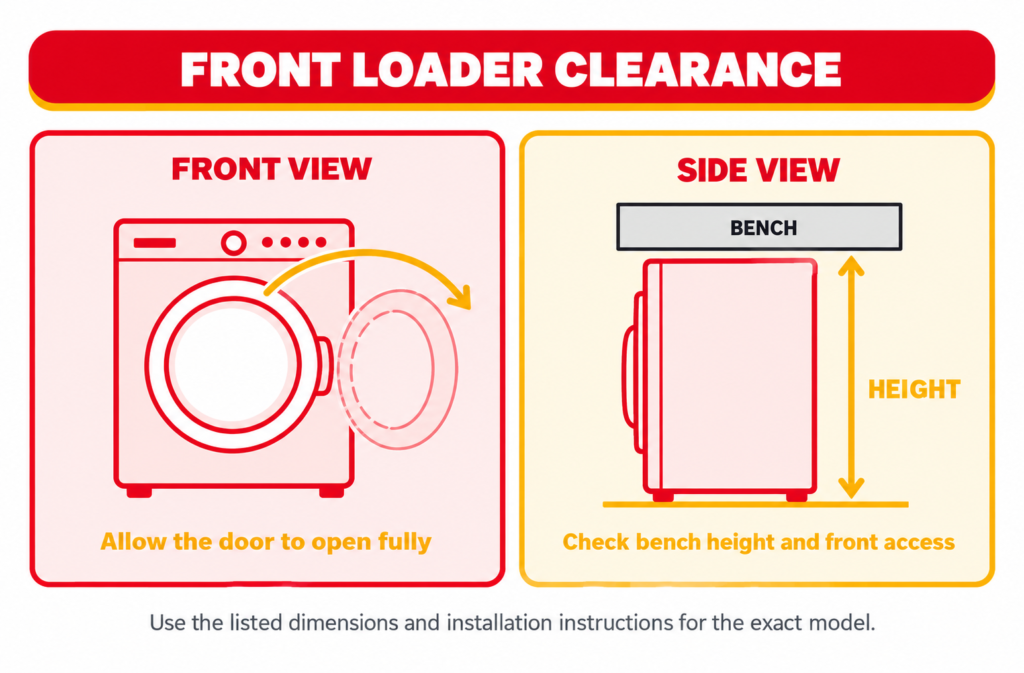
Front-loader clearance diagram.
Measuring for a top loader
Overhead and lid clearance
Measure the machine with the lid fully raised, using the product specifications or installation diagram. The closed height alone does not show the vertical space needed during use. Leave enough room to load items without holding the lid partly open.
Shelving above the machine
Check the lowest shelf, cabinet, or hanging rail above the intended position. It must clear the open lid and should not obstruct access to the drum. If shelving is adjustable, confirm its final position before measuring.
Access requirements
Plan for comfortable access at the front and above the appliance. Check that nearby doors, baskets, or cabinetry will not restrict loading, controls, taps, or servicing once the machine is installed..
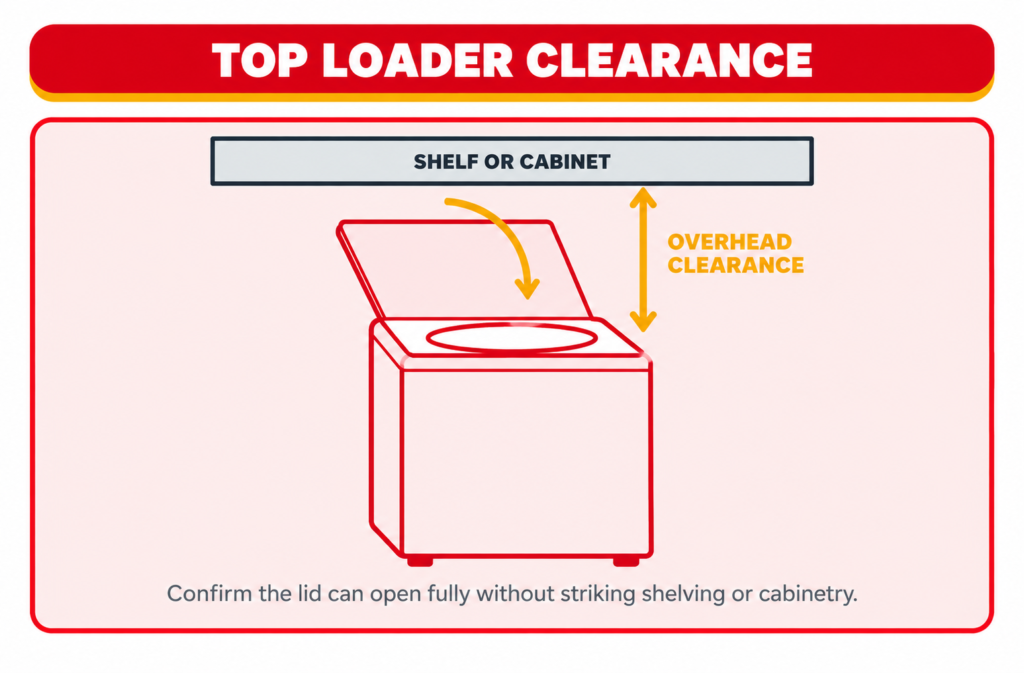
Top-loader clearance diagram.
Measuring for a dryer
Width, height, and depth
Measure the intended dryer space at several points and use the narrowest width and height. Measure depth from the back wall to the available front edge, allowing for any plug, ducting, door profile, or other protruding part. Compare these figures with the exact model’s specifications and required installation clearances. A dryer placed beside a washer needs its own space; do not assume matching capacities mean matching exterior dimensions.
Door and loading clearance
Check the dryer door’s full swing and the clear floor area needed to load and unload it. Note the hinge side and nearby walls, cabinets, laundry doors, or a washer door. If the dryer is mounted or stacked, make sure the controls and drum opening remain comfortable to reach at the final height.
Ventilation and moisture management
Dryer requirements depend on the type and model. A vented dryer may need a suitable exhaust route, while a condenser or heat pump dryer may require specified airflow around the appliance and a way to empty or drain collected water. Check the manufacturer’s instructions for ventilation, heat clearance, drainage, and any restrictions on enclosed spaces. Do not block vents or assume that every dryer can be installed inside a closed cupboard.
Power and installation position
Confirm the power point is accessible and suitable for the chosen appliance. If the dryer will be wall-mounted or stacked, check the model’s approved mounting method, the supporting structure or compatible washer and kit, the combined height, and the room needed above and around both appliances. Follow the manufacturer’s instructions and arrange qualified installation where required.
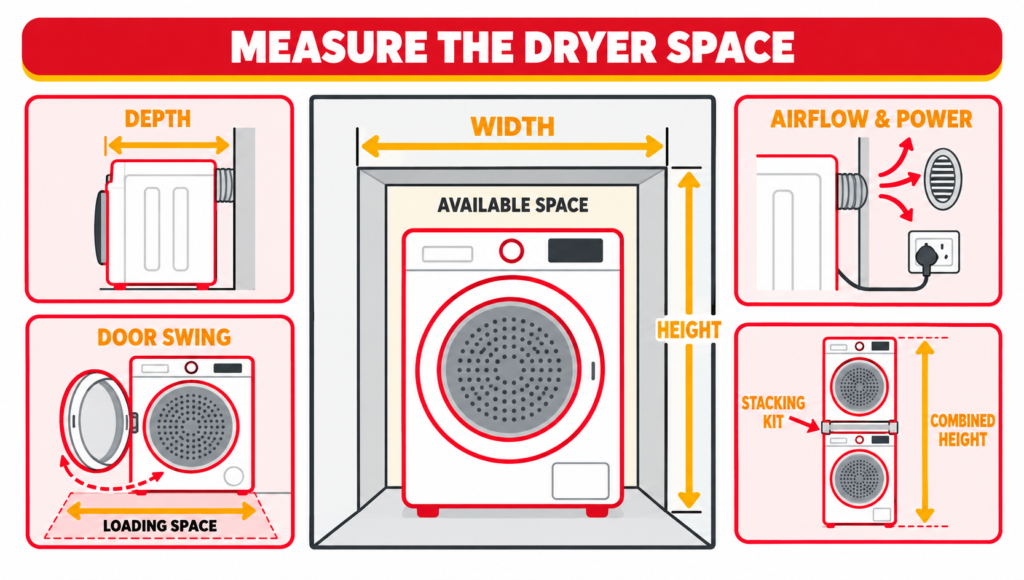
Once you have your measurements, compare our dryer range or see our full laundry appliance range.
Considering a washer–dryer combo
A washer–dryer combo washes and dries in one appliance, which may suit a laundry without room for two separate machines. Measure its width, height, and depth as you would for a front loader, including the open door, hose and drain routes, power point, ventilation, and any under-bench clearance. Check the specific model’s installation instructions; a single appliance still needs operating space and accessible connections.
Compare both its washing and drying capacities before choosing. The drying load may be smaller than the washing load, so a full wash may need to be dried in separate batches. Also consider how long a wash-and-dry cycle takes and whether the combo suits the amount of laundry your household handles.
Check the delivery route
Measure the narrowest opening and tightest turn from the property entrance to the laundry. Compare these with the selected appliance’s packaged dimensions, if available. Check that the appliance can pass through the laundry doorway and turn into position.
For a full checklist covering doors, hallways, stairs and lifts, see our Home Fit Guide. If access is tight or packaged dimensions are unavailable, contact Lightning Rentals before arranging delivery.
Always check the specific product’s dimensions
Washing-machine dimensions vary by model, including products within the same capacity category. Compare your recorded space, operating clearance, connection space, and delivery route with the measurements on the individual listing before renting. You can review our range of washing machines or browse our full laundry appliance range once your measurements are ready.
Apply the same check to a dryer or washer–dryer combo. For a separate dryer, confirm its ventilation or drainage arrangement and the final height if it will be mounted or stacked. For a combo, check both its installation dimensions and its separate washing and drying capacities.
Lightning Rentals supplies laundry appliances under consumer leases. A consumer lease lets you use the goods for an agreed period while making regular payments, and ownership does not transfer automatically at the end. Before applying, review the lease term, payment frequency, total amount payable, fees, and end-of-lease conditions. The Consumer Leasing in Australia Complete Guide explains these points in detail.
Laundry Fit FAQs
What is the standard width of a washing machine?
Many front-loading machines are approximately 595–600 mm wide, but there is no single width that applies to every model. Top loaders and large-capacity machines can differ considerably. Use general ranges only for orientation and check the listed width of the exact appliance.
How much space do I need behind a washing machine for plumbing?
There is no universal rear-clearance figure because hose positions, taps, plugs, and installation requirements vary. Allow enough room to prevent hoses or the plug from being crushed, then follow the manufacturer’s instructions for the selected model.
Can a front loader be installed under a bench?
Many front loaders can fit beneath a bench if the opening provides the required height, width, depth, ventilation, and connection access. Check the model’s installation instructions and avoid assuming that all front loaders share the same dimensions.
Do I need extra clearance for a top loader’s lid to open fully?
Yes. Measure the total height with the lid fully raised and check shelves, cabinets, or rails above the machine. You should also leave enough access to load the drum comfortably.
What happens if my laundry doorway is too narrow for delivery?
Contact Lightning Rentals before arranging delivery so the access issue can be assessed. Do not assume that a door or part of the appliance can be removed. A different model or another suitable delivery arrangement may be needed.
Do all washing machines have the same dimensions?
No. Dimensions vary between brands, formats, capacities, and models. Always compare the individual product specifications with your laundry space and complete delivery path.
Can a dryer be installed inside a closed cupboard?
Not every dryer suits an enclosed space. Vented dryers need an exhaust route, and condenser and heat pump dryers need the airflow clearance specified by the manufacturer. Check the model’s installation instructions before planning a cupboard or alcove position, and never block the vents.
Can I stack any dryer on any washing machine?
No. Stacking needs compatible appliances, a manufacturer-approved stacking kit, stable flooring, and enough total height for both machines. Confirm the washer, dryer, and kit are designed to work together before choosing a stacked setup.
Complete your laundry fit check
Record your recess measurements, operating clearance, connection space, and delivery access before comparing products. Keep those figures beside you when reviewing a listing so you can check the exact model rather than relying on standard dimensions.
If you are comparing a separate dryer or a washer–dryer combo, add the relevant ventilation, drainage, door-swing, and installed-height checks to your notes.
Measurements ready? Compare washing machines and dryers that suit your space.